The Archive

A small museum of two movements.

Primary source material spanning from the 1930 Salt March to the week Dr. King died. Each item is catalogued by provenance so visitors can tell what they're looking at. Selected items travel with the Season for Nonviolence kickoff each year. Institutional loans are welcomed.

Original artifact (one-of-a-kind) Period original (mass-produced at the time) Reproduction (modern replica for display)

Featured exhibit

Originals

Primary source material

Items shown in museum archival frames are housed in conservation-grade enclosures with UV-protective glazing and acid-free mat board for active preservation.

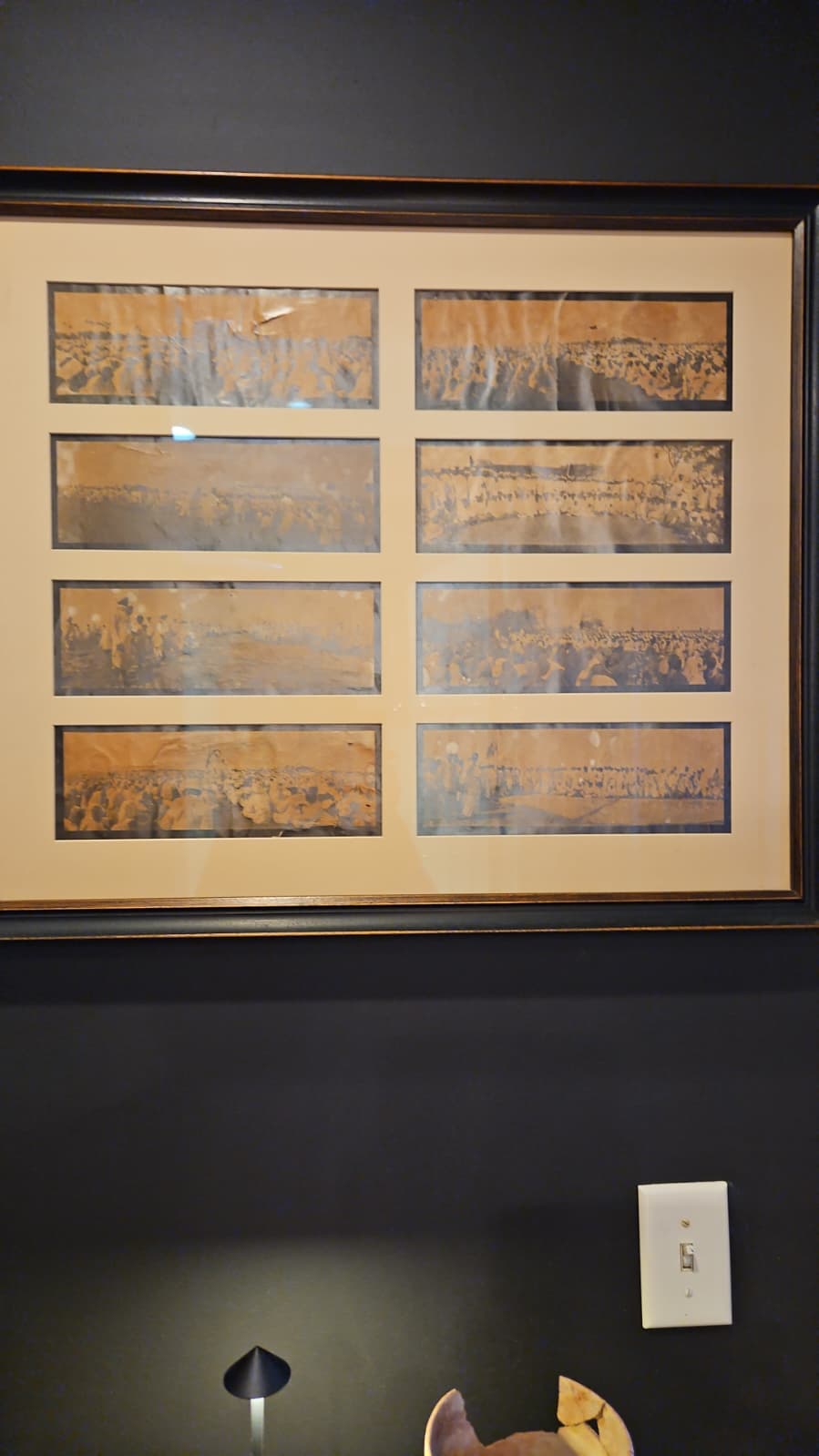
Eight panoramic Salt March photographs in a museum archival frame
Original artifact
1930

Salt March photographs

Eight panoramic photographs from Mahatma Gandhi's 240-mile Salt March to Dandi. Provenance: received directly from the grandson of the photographer who was present at the march. Genealogical chain of custody back to the original lens. Displayed in museum archival frame.
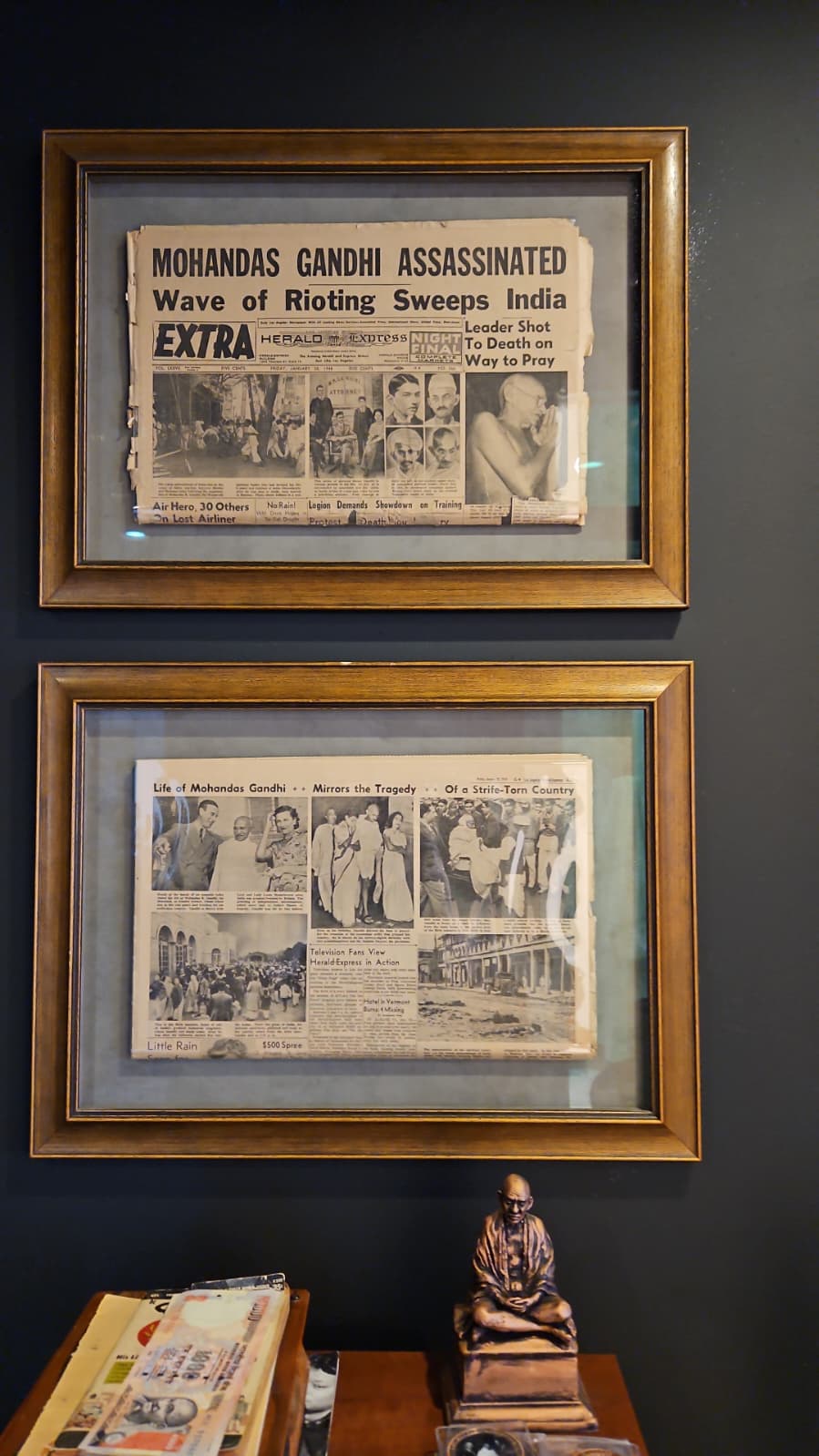
Front pages of the Herald-Express EXTRA edition of January 30, 1948 announcing Gandhi's assassination, in museum archival frame
Original artifact
January 30, 1948

Gandhi assassination front pages

The Herald-Express EXTRA edition of January 30, 1948: "MOHANDAS GANDHI ASSASSINATED / Wave of Rioting Sweeps India / Leader Shot to Death on Way to Pray." Companion paper on the life of Gandhi mirroring the tragedy of a strife-torn country. The Season for Nonviolence begins on this date each year.

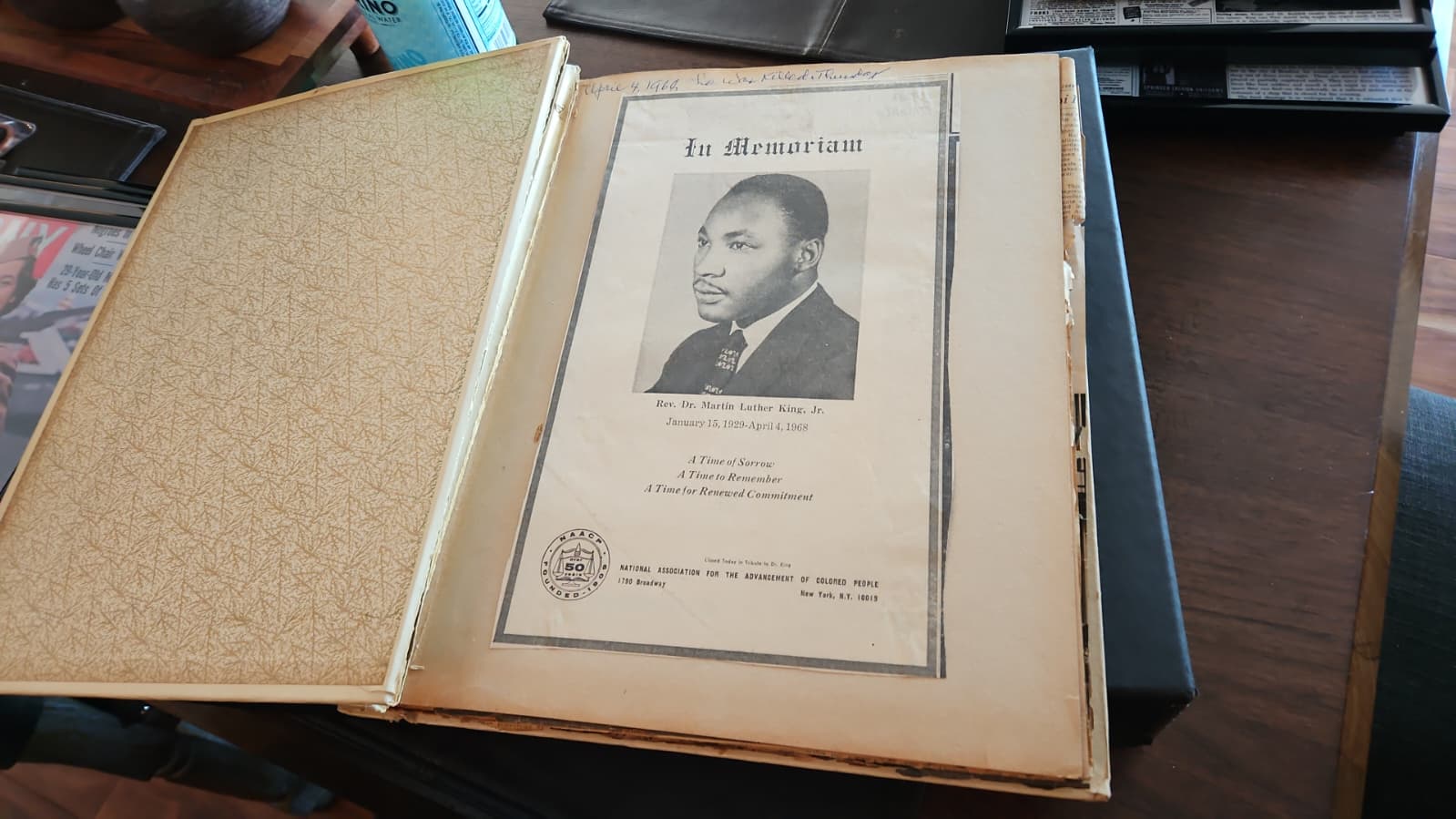
A scrapbook opened to an NAACP In Memoriam page for Dr. Martin Luther King Jr., with a handwritten annotation at the top reading 'April 4, 1968. He was killed Thursday.'
Original artifact
April 1968

In Memoriam scrapbook

A scrapbook assembled in the days after Dr. King's assassination. Opens to the NAACP "In Memoriam" page with a handwritten annotation at the top: "April 4, 1968. He was killed Thursday." The handwriting is itself the artifact, documentation in real time, not curation after the fact. The Season for Nonviolence closes on April 4 each year.

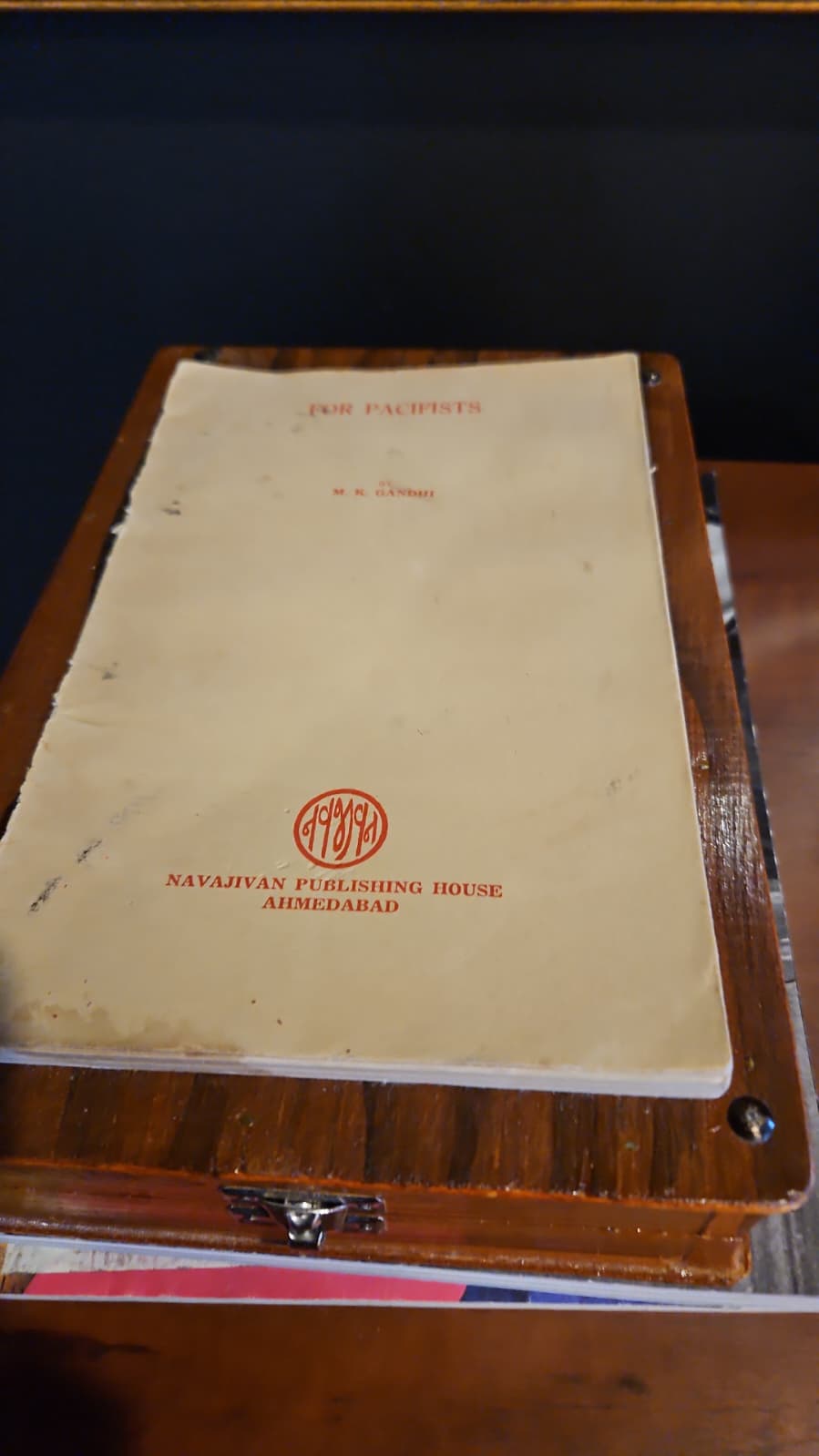
Front cover of 'For Pacifists' by M.K. Gandhi, published by Navajivan Publishing House, Ahmedabad
Original artifact
1949

For Pacifists, by M.K. Gandhi

First edition. Published 1949 by Navajivan Publishing House of Ahmedabad, the publishing house Mahatma Gandhi founded in 1929. Issued the year after his assassination. A collection of Gandhi's writings on pacifism originally published in Harijan and Young India.

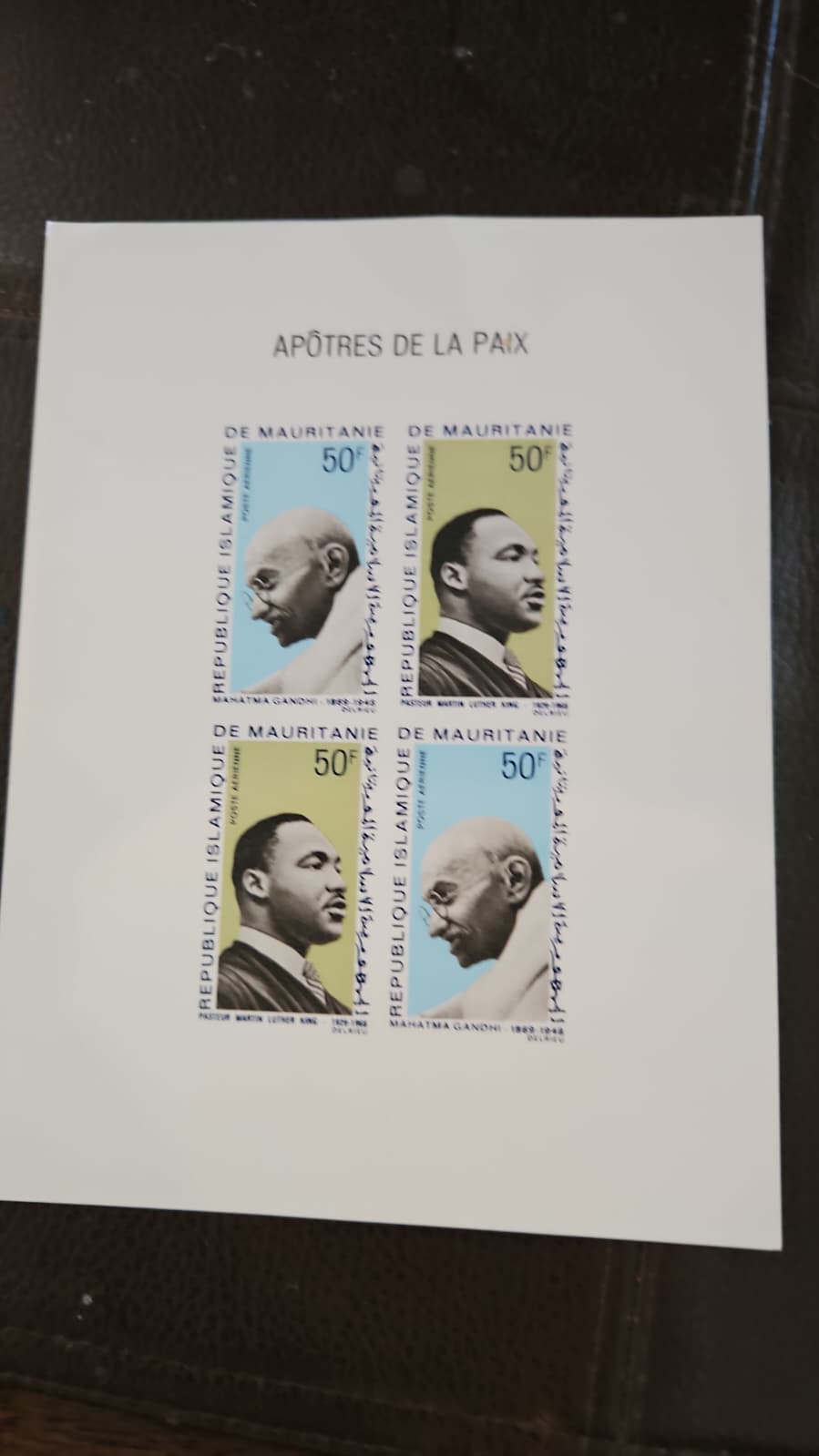
An unperforated printer's proof sheet of four Mauritania airmail postage stamps titled 'Apotres de la Paix' featuring Mahatma Gandhi and Dr. Martin Luther King Jr.
Original artifact
Late 1960s

Mauritania «Apôtres de la Paix» stamp proof

Printer's proof sheet, pre-production, for a series of airmail postage stamps from the République Islamique de Mauritanie titled Apôtres de la Paix ("Apostles of Peace"). Pairs Mahatma Gandhi (1869-1948) with "Pasteur Martin Luther King" (1929-1968) on four 50-franc stamps. Designed by Delrieu. Unperforated, blank margin: never went to production in this form.

Period originals

Mass-produced in their era

Items produced at scale at the time of the events they document. Held by the center because they carry the visual and material vernacular of their moment.

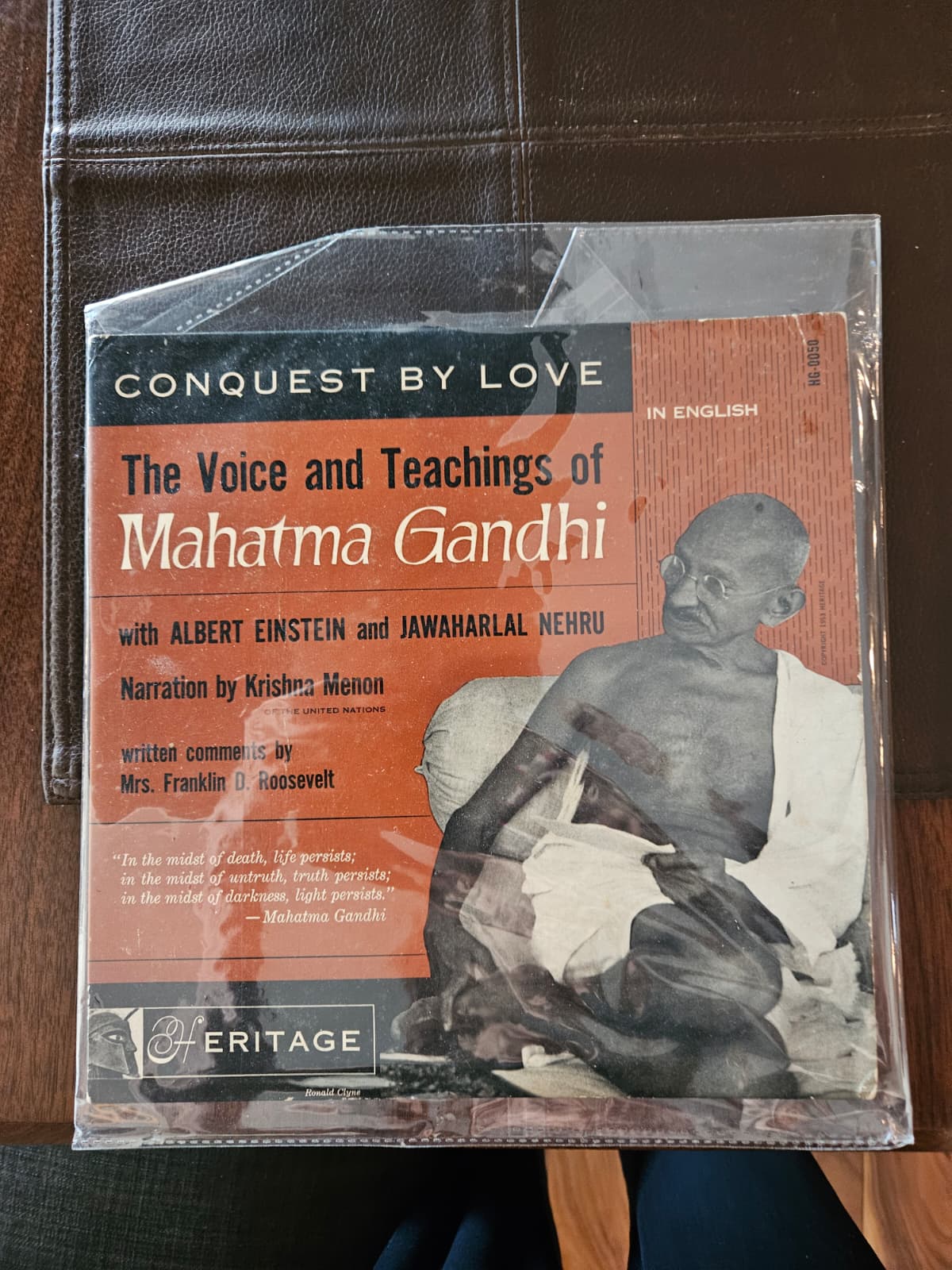
Album cover of 'Conquest by Love: The Voice and Teachings of Mahatma Gandhi' Heritage Records HG-0050, with Albert Einstein, Jawaharlal Nehru, narration by Krishna Menon, and written comments by Mrs. Franklin D. Roosevelt
Period original
1953

Conquest by Love (Heritage Records)

Heritage Records HG-0050, in English. The voice and teachings of Mahatma Gandhi, with Albert Einstein and Jawaharlal Nehru, narration by Krishna Menon of the United Nations, and written sleeve comments by Mrs. Franklin D. Roosevelt. Sleeve quote: "In the midst of death, life persists; in the midst of untruth, truth persists; in the midst of darkness, light persists."

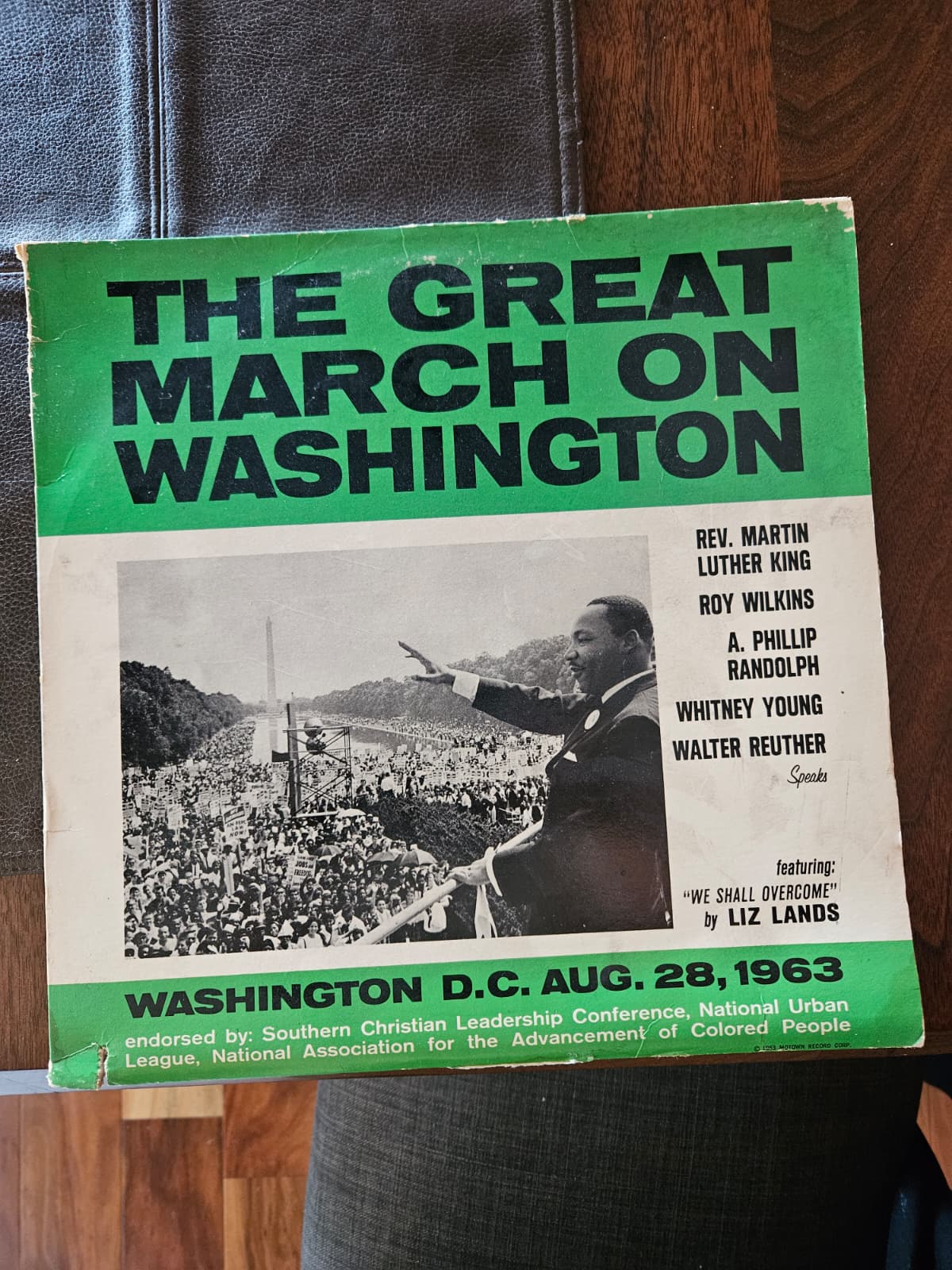
Album cover of 'The Great March on Washington' Motown Record Corp. 1963, with Rev. Martin Luther King, Roy Wilkins, A. Philip Randolph, Whitney Young, Walter Reuther, and 'We Shall Overcome' by Liz Lands
Period original
August 28, 1963

The Great March on Washington (Motown)

Motown Record Corporation, 1963. Live audio from the August 28, 1963 March on Washington for Jobs and Freedom: Rev. Martin Luther King, Roy Wilkins, A. Philip Randolph, Whitney Young, Walter Reuther. Includes "We Shall Overcome" by Liz Lands. Endorsed by SCLC, the National Urban League, and the NAACP.

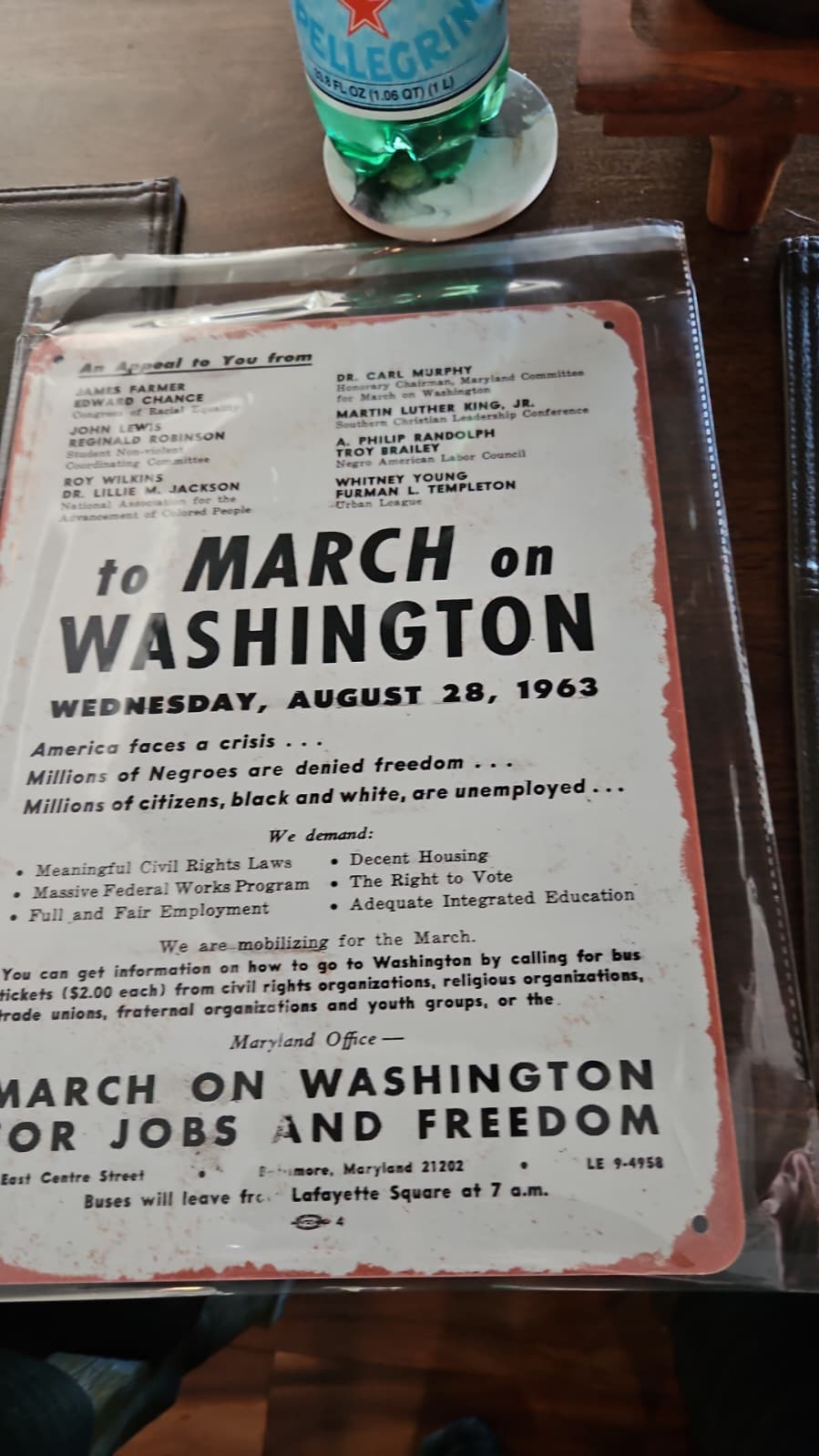
Original recruitment poster for the March on Washington, Wednesday August 28 1963, signed by James Farmer, John Lewis, Roy Wilkins, MLK, A. Philip Randolph, Whitney Young, Carl Murphy, Troy Brailey, Furman Templeton, Edward Chance, Reginald Robinson, and Dr. Lillie M. Jackson
Period original
August 28, 1963

March on Washington recruitment poster

"An Appeal to You from" James Farmer, John Lewis, Roy Wilkins, MLK, A. Philip Randolph, Whitney Young, Carl Murphy, Troy Brailey, Furman Templeton, Edward Chance, Reginald Robinson, and Dr. Lillie M. Jackson. Distributed by the Maryland Office of the March on Washington for Jobs and Freedom. Buses leaving Lafayette Square at 7 a.m. Tickets $2.

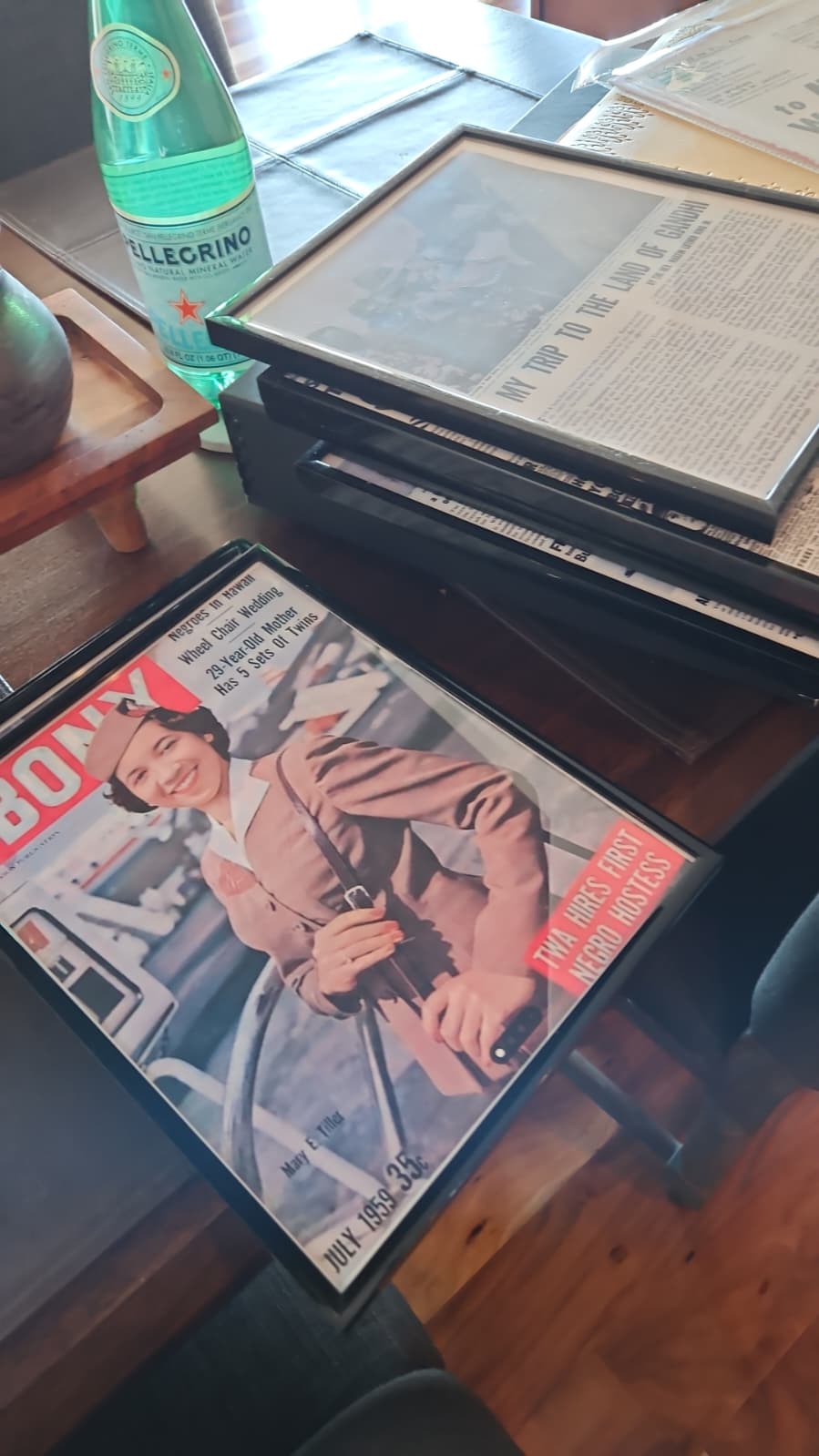
Framed pages of Dr. King's 1959 Ebony magazine article 'My Trip to the Land of Gandhi'
Period original (restored)
July 1959

"My Trip to the Land of Gandhi" (Ebony)

Dr. King's published account of his February-March 1959 trip to India, in Ebony magazine. Notable for its rarity: even the Stanford MLK Institute could supply only a near-illegible scan. The center's display copy was digitally restored from that scan, each page individually framed, with color reproductions distributed free at Season for Nonviolence events. See the full Kings in India exhibit →

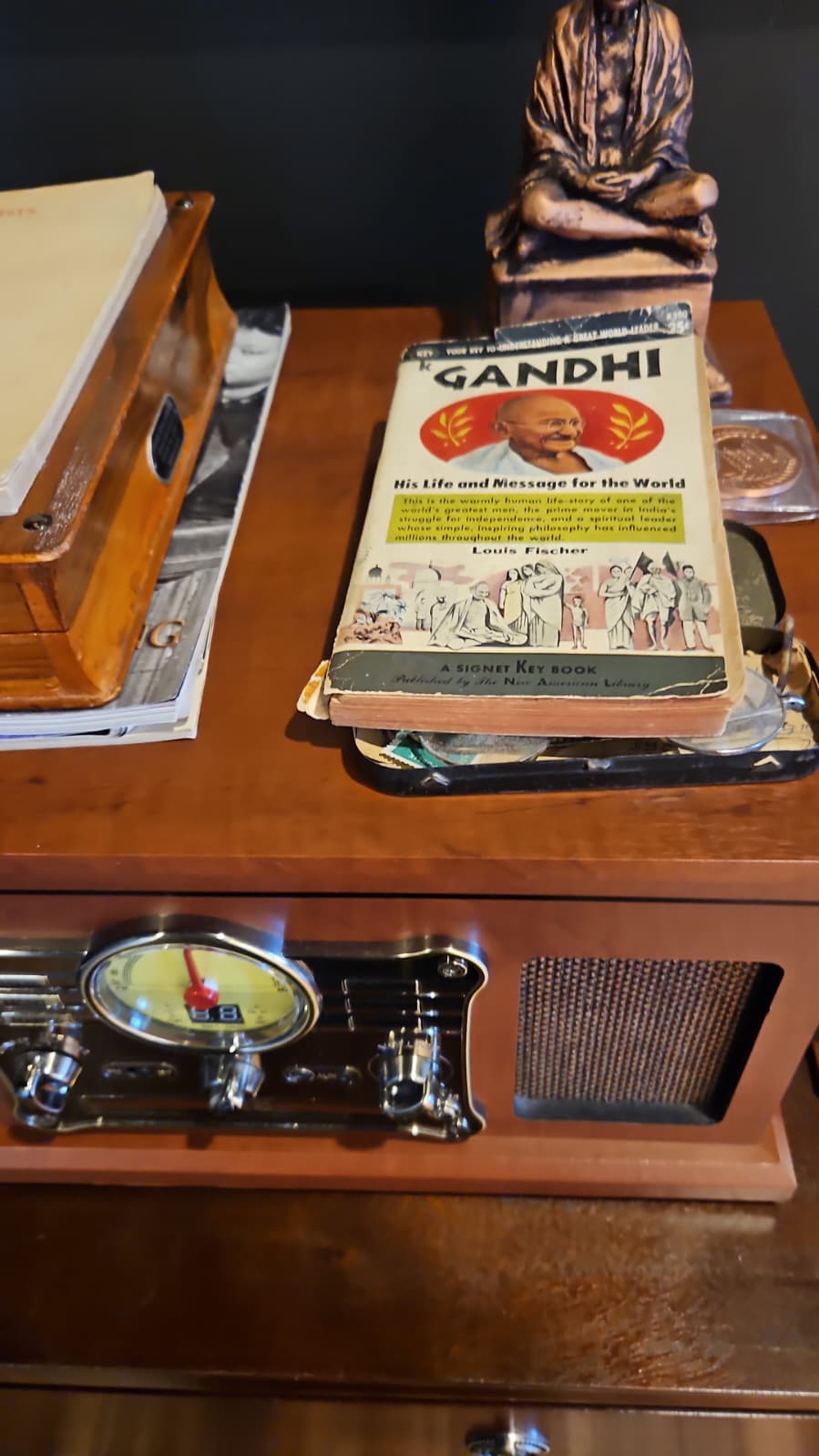
Cover of 'Gandhi: His Life and Message for the World' by Louis Fischer, a Signet Key Book paperback edition
Period original
c. 1954

Gandhi: His Life and Message for the World

By Louis Fischer. Signet Key Book, published by the New American Library. The 1954 mass-market paperback edition of Fischer's 1950 biography. The book that introduced Gandhi to a generation of American readers and later served as a primary source for Richard Attenborough's 1982 film.

Reproductions

Modern replicas for display

Replicas serve a teaching function: visitors can hold or see at close range what the originals were like, without exposing irreplaceable artifacts to handling. The center is explicit about which items are replicas because that distinction is what protects the credibility of the originals.

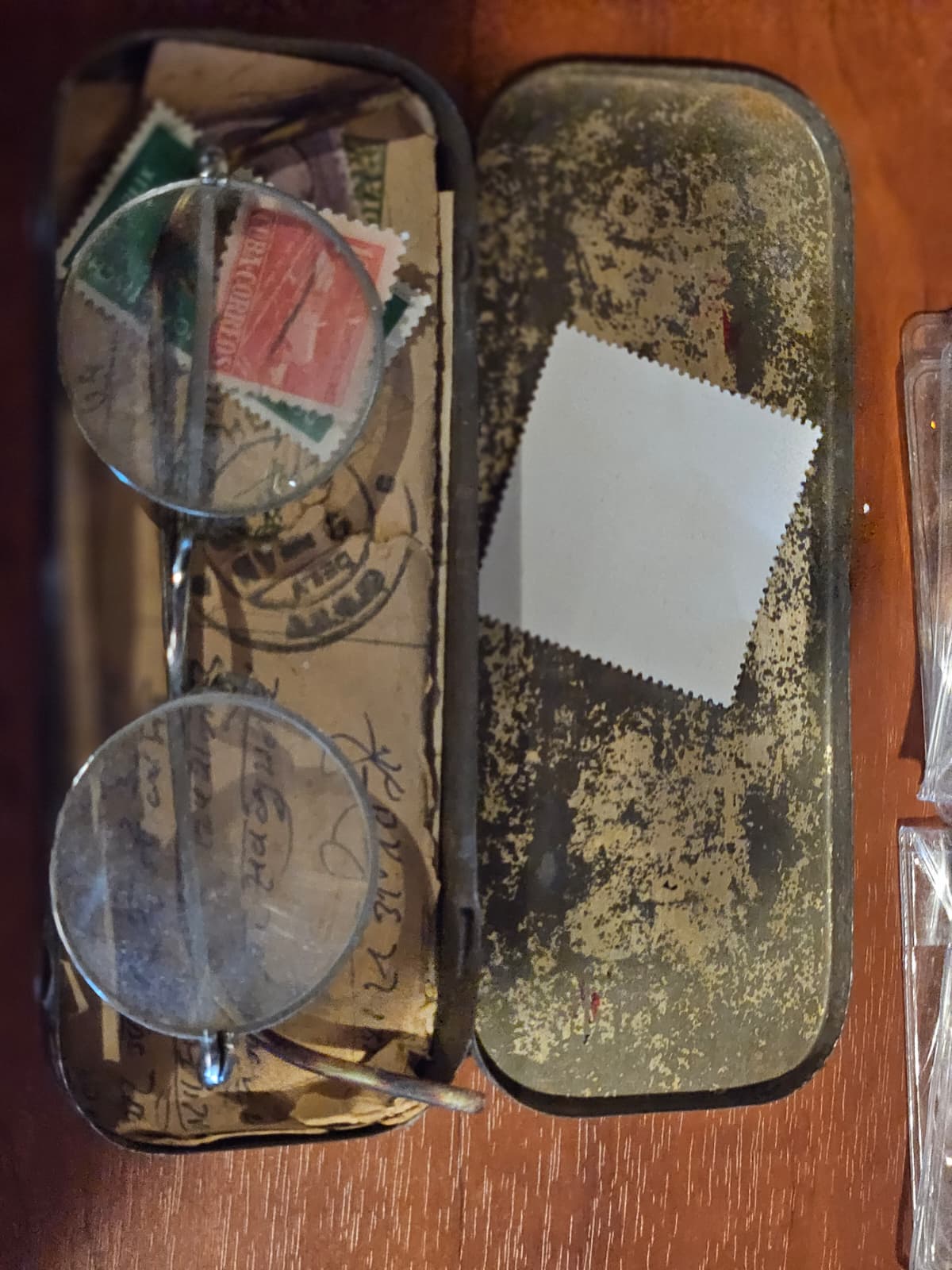
A pair of replica Gandhi-style round eyeglasses in a vintage metal case lined with period postage stamps and handwritten notes
Reproduction
Display, modern

Gandhi-style eyeglasses

Replica round-frame eyeglasses in the style most associated with Mahatma Gandhi. Housed in a vintage metal case lined with period postage stamps and handwritten notes. Used as a teaching display alongside the original photographs and writings.

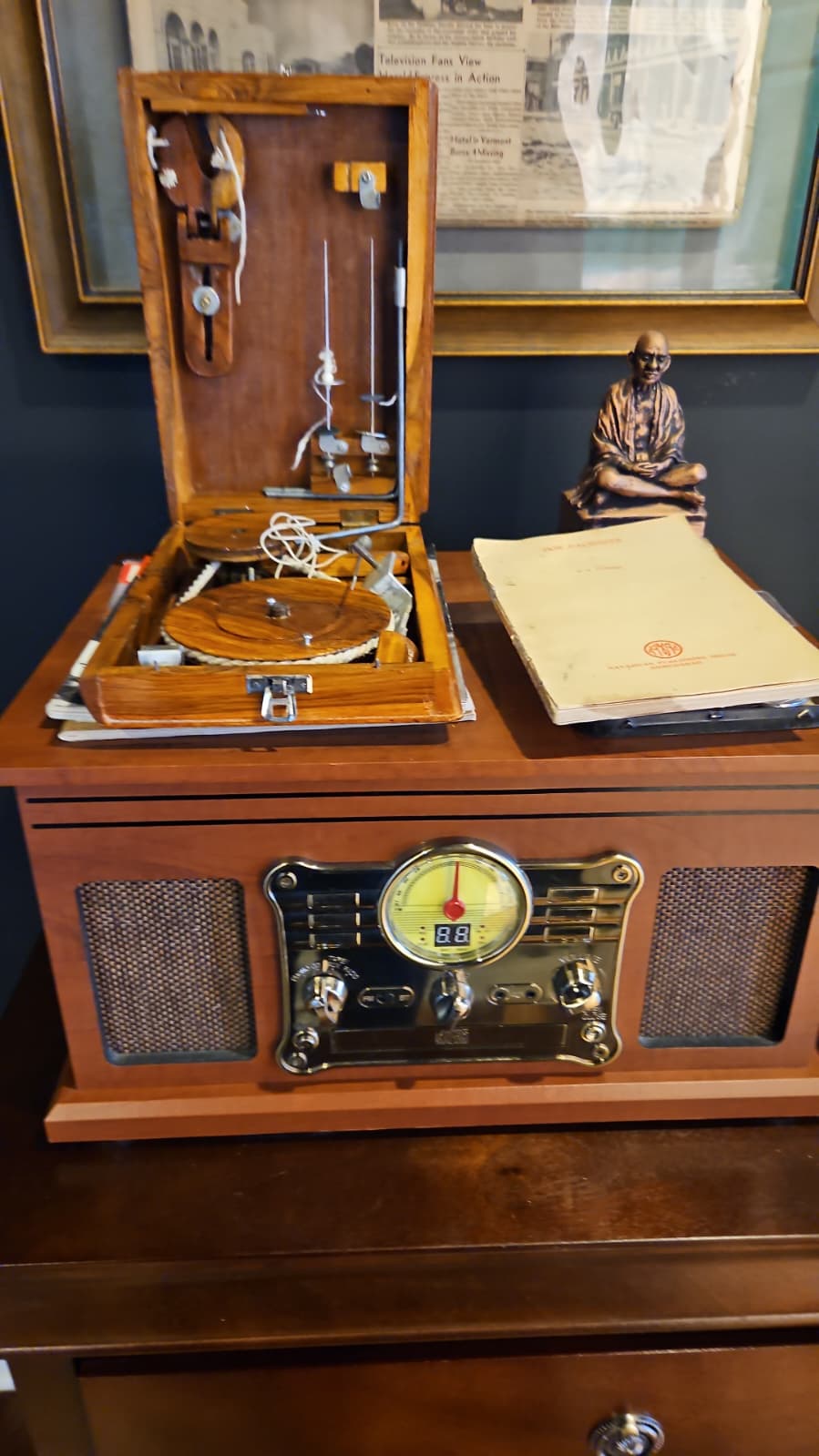
A reproduction wooden book charkha, a portable spinning wheel of the type associated with Mahatma Gandhi, in a wooden box
Reproduction
Display, modern

Book Charkha (portable spinning wheel)

Reproduction of the portable "book charkha," the folding wooden spinning wheel Mahatma Gandhi carried as a daily practice of self-reliance and a visible refusal of British textile imports. The charkha became the central image of the Indian independence movement and is depicted at the center of the Indian flag's first design.

Annual artifact program

The Gandhi-King Challenge Coin Series

Each year for the Season for Nonviolence event, the Gandhi-King Center commissions a custom challenge coin. Each design is approved by representatives of the Gandhi and King families before production. The result is a small annual ritual of mutual consent across both lineages, and a growing collection of artifacts unique to the Season.

Photographs of the annual coin series will be added as the collection grows.

Beyond display

Screenings and traveling exhibits

Let's Kill Gandhi (film)

Tushar Gandhi and the Gandhi-King Center hold screening rights to Let's Kill Gandhi, the historical drama on the conspiracy behind Mahatma Gandhi's assassination, granted directly by the director. The film is offered for institutional screening alongside discussion programming.

Traveling exhibits

Selected artifacts from the archive travel with the Season for Nonviolence kickoff each year, and many items have been displayed temporarily at libraries, archives, and schools that request them. To inquire about a film screening, an archive loan, or a traveling exhibit, use the form below.

Request a loan or screening

Borrow an item or host a screening

If you represent a library, school, museum, civic organization, or congregation that would like to host items from the archive or screen Let's Kill Gandhi, submit the form below. We respond within two weeks and will follow up with specifics on shipping, insurance, and scheduling.